How ADHD People Thrive at Work: 5 Environmental Features To Consider
There is a tendency to talk about ADHD in workplaces as though it exists entirely inside the person. Focus. Time management. Attention. Organization.
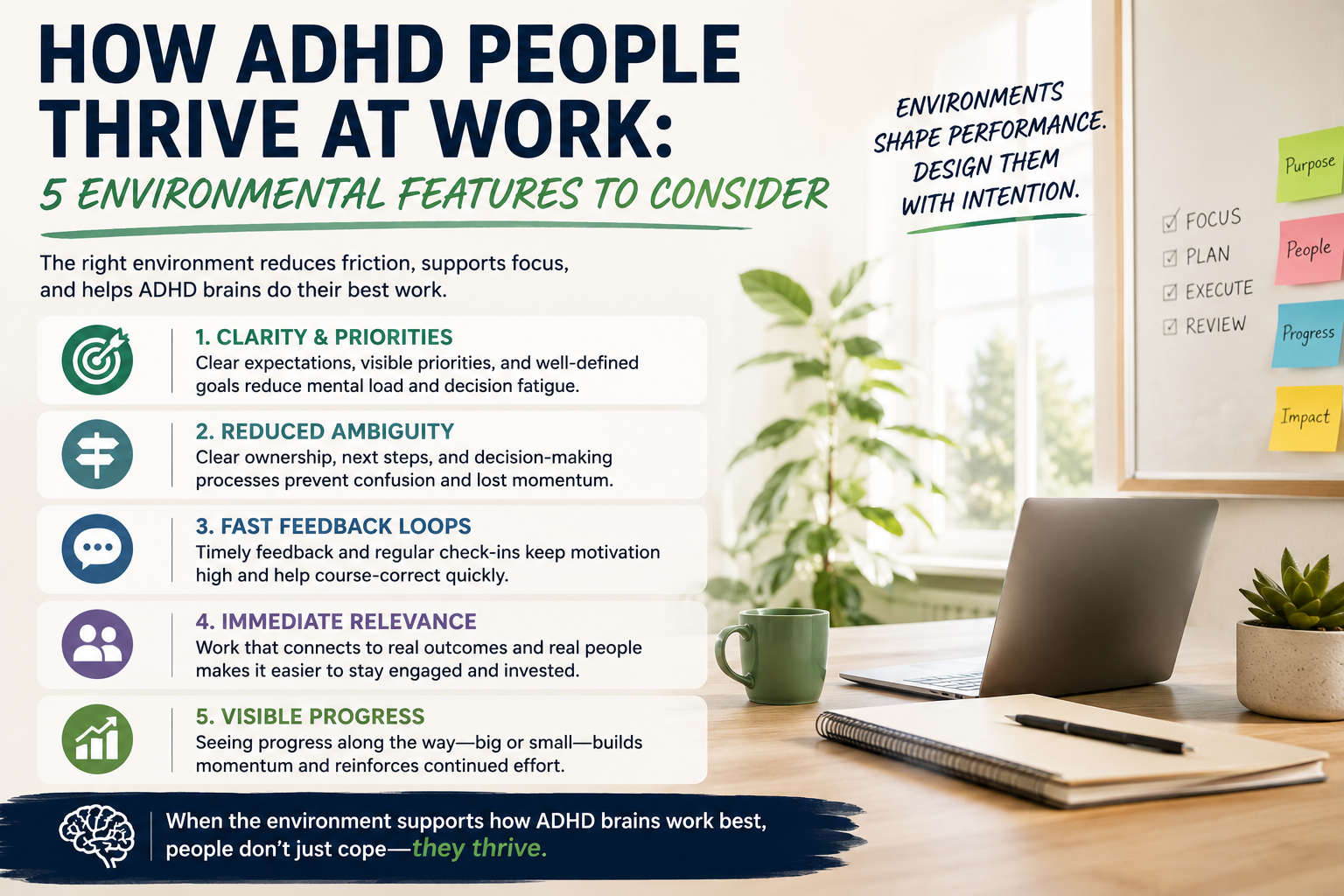
But in my experience, ADHD performance is heavily shaped by environment. Some environments create momentum, clarity, and engagement. Others create constant cognitive friction. Many ADHD adults spend years assuming they are the issue, when in reality they are operating inside systems that make sustained performance unnecessarily difficult.
One of the biggest differences I have noticed is the difference between visible and invisible work.
ADHD people often thrive when work feels concrete, observable, collaborative, and active. When progress can be seen, discussed, tracked, or interacted with, it becomes easier to maintain momentum and attention. Invisible work environments tend to create the opposite effect. Tasks become abstract, disconnected, and difficult to sequence mentally. Priorities blur together and progress becomes harder to measure.
A few workplace conditions consistently seem to help ADHD professionals thrive:
Clear expectations and visible priorities
Reduced ambiguity around ownership and next steps
Fast feedback loops instead of delayed evaluation
Immediate relevance and connection to real outcomes
Collaborative work that involves interaction and movement
Variety, novelty, and changing problem-solving demands
Visible progress instead of long periods without reinforcement
Reduced ambiguity is enormous.
I personally struggle in environments where expectations are vague, decisions stay unresolved for long periods of time, or communication relies heavily on implication instead of clarity. ADHD brains often spend significant energy trying to interpret the environment or the "ask" before even beginning the task itself. That constant interpretation becomes exhausting.
This is one reason many ADHD adults thrive in fast-moving or high-accountability environments. While those environments can overwhelm some people, they often provide the exact things ADHD brains respond well to: visible movement, immediate relevance, quick feedback, collaboration, and clear signals about what matters.
The modern workplace often creates the opposite.
Many jobs now involve invisible digital work spread across tabs, platforms, dashboards, and asynchronous communication. Employees are expected to manage shifting priorities with limited clarity while independently organizing large amounts of information that rarely feels tangible or complete. For ADHD professionals, this can create a constant sense of fragmentation, confusion, and the feeling of completing random, isolated tasks rather than meaningful work.
What is interesting is that the solutions are often not complicated. ADHD-thriving environments are usually just better designed environments.
Five Things To Consider
Make priorities visible. A shared project board, clear task list, or visible workflow reduces the mental effort required to “figure out what matters.”
Reduce ambiguity in communication. Instead of “let’s revisit this later,” define who owns the task, what the next step is, and when it should happen.
Break large projects into visible stages. ADHD brains often respond better to movement and progression than distant end goals. Jira is a helpful tool for doing this.
Create shorter feedback loops. Waiting weeks or months for performance feedback disconnects effort from reinforcement.
Reduce unnecessary digital fragmentation. Fewer platforms, fewer tabs, and clearer organizational systems matter more than most organizations realize. See Toby.
Despite what we have all heard, ADHD is not simply about distraction. We have moved past thinking it's only about distractibility. In many cases, ADHD is about how the brain responds to motivation, clarity, stimulation, uncertainty, and reinforcement within an environment.
When organizations design with these realities in mind, ADHD professionals often do far more than “cope” at work.
They thrive.
Next, we’ll look at feedback for people with ADHD, including the types of feedback, reinforcement, and communication patterns that help people thrive at work.